Success Stories
by Troy Lanigan February 2011

It’s hard to call a successful public policy campaign a victory, as victory signifies finality. When it comes to public policy, there is rarely a final victory or final defeat. For example, the successful fight led by the CTF to balance budgets and secure laws that outlawed deficits in the 1990s, is being fought once again.
The CTF has fought many a public policy battle since its founding in 1990 and we’ve had our share of ups and downs. The following is a brief summary of just some of those campaigns where the CTF can tangibly point to its involvement having made a significant difference. Importantly, the CTF does not claim to have achieved anything on this list in isolation. But does claim -- in all instances -- to have played a leading role.
BALANCING BUDGETS
Years of consecutive and
uncontrolled deficits through the 1970s and 1980s racked up by federal and
provincial governments were a catalyst for the CTF’s creation. In 1993 the CTF
commissioned the construction of a National Debt Clock – 12 feet long, 8-and-a-half
feet high – with changeable faceplates for the federal and each provincial
government. The clock displayed the per-second increase in debt along with
increasing debt for the average family of four. In a modified horse trailer,
the clock was toured across the country and made headlines wherever it was set
up.
At every turn, the CTF challenged politicians and organized significant petition campaigns aimed at balanced budget legislation. It paid off. First in several provinces and later federally, the country as a whole gradually moved from red ink to black ink.
In the years between 1997 and 2008 the federal government alone re-paid $105-billion in debt.
Unfortunately, 2008 marked a return to deficit spending. In early 2009, the CTF launched an online debt clock and petition at www.DebtClock.ca. But it wasn’t quite the same.
In 2010 the CTF brought the original National Debt Clock out of retirement and began to patch the Champ up for a comeback. It needed a complete facelift, all-new electronics, a new trailer and a new ride. But by February 2011 she was ready to depart Mile 0 of the TransCanada Highway in Victoria, BC and make her way to the Atlantic coast – once again sounding the alarm for fiscal responsibility and a return to balanced budgets.
THE “OLSON BILL”
When the CTF learned in 2010 that serial child-killer Clifford Olson was collecting Old Age Security and the Guaranteed Income Supplement, we got organized. We quickly gathered 46,000 signatures and delivered them to federal Human Resources Minister Diane Finlay who responded with Bill C-31. That Bill sought to end low-income support payments to all incarcerated seniors.
The CTF issued statements, conducted media interviews and federal director Kevin Gaudet testified in support of the bill to committees of both the House of Commons and Senate.
On December 15, 2010 the Bill received royal assent and became law of the land effective January 1, 2011. It was a clear victory for the CTF: saving taxpayers $10 million a year and demonstrating that citizens can make a difference!
ABORIGINAL POLICY REFORM
For years, the CTF has blazed a trail challenging conventional wisdom concerning Aboriginal policy and building the case for change where others would not for fear of “political correctness.” Case in point: the Treaty 8 taxation case (Benoit v. Canada). At issue was Treaty 8 Indian Gordon Benoit who claimed an oral promise made to his ancestors in 1899 exempted him and all Treaty 8 Indians from having to pay any tax, for all time, anywhere in Canada.
Your CTF intervened in this case to argue what politicians would not: that a race-based tax exemption would violate equality provisions of the Charter, numerous international treaties, conventions against racism and basic principles of fairness.
If someone does not pay tax it should be because they are poor, not because of their racial ancestry.
While the CTF first lost the case in 2002, we won on appeal in 2003 and the Supreme Court of Canada finally dismissed the matter in 2004, winning a big victory for the equality of Canadian taxpayers. The CTF is guided by the principles of support for individual property rights, equality, self-sufficiency, as well as democratic and financial accountability.
In 2010 for example, the CTF created a website, ReserveTransparency.ca to assist band members in learning about their rights in obtaining band financial information. The site was in response to the CTF receiving and publicizing “brown envelope” information dropped at CTF offices disclosing exorbitant salaries paid to some band chiefs and councilors.
The CTF did further investigation with the federal government and pried loose information showing that in 2008-09, there were 50 reserve politicians that earned more than the prime minister, approximately 160 that received more than their respective premier and over 600 that had an income equivalent to about $100,000. The data also showed the average reserve in Canada has a population of approximately 1,142 people.
However, the data did not include any names.
Reasonable people can debate pay levels, but it seems ridiculous that in 2011 citizens don’t have access to how much their elected officials are being paid. In response to the CTF’s
efforts, MP Kelly Block tabled a private members bill – C-575 -- that would put the salary information for every reserve politician in Canada online. Summed the Globe and Mail: “to disclose the salary and expenses of chiefs and councilors paid with federal funds is a needed step.” Incredibly, the Opposition parties support keeping the salaries secret.
The CTF has made several appearances before committees and published many reports to challenge a status quo that has hurt both natives and taxpayers alike. In July 2008, a new law came into effect that allows the federal government – for the first time in 141 years – to audit the books of reserves to ensure tax dollars are being used for their intended programs and services. We hope a law that provides disclosure of band councilor salaries follows.
POLITICIANS PAY REFORM
Across Canada the CTF has successfully sought reform of legislators’ compensation around the guiding
principles of transparency, fairness and simplicity. Specifically, the CTF has
opposed gold-plated pensions and so-called “tax-free allowances” that exempted
one-third of legislators’ salaries from federal and provincial income taxes.
This is an important watchdog role for the CTF, as opposition politicians who
should be blowing the whistle are often themselves wallowing in the same trough
as government members.
The CTF is the only organization in the country that regularly calculates and releases the details of politicians’ pensions and benefits. Without the CTF, taxpayers would never know these details. Change has generally been built around petitions, the opportunity to make detailed submissions to compensation review panels and significant media coverage.
In Ontario, BC and Manitoba, legislators implemented a fully taxable salary and reformed their pension arrangements to a dollar-for-dollar, self-funding plan (Saskatchewan implemented a self funding plan in 1979). Alberta abolished their gold-plated plan in 1993 and replaced it with an RRSP allowance. In 2001, federal parliamentarians finally adopted a fully taxable salary as did legislators in Saskatchewan in 2006. Incredibly, in 2007, British Columbia legislators became the first to re-instate gold-plated pensions.
Within four months of establishing a full-time presence in Atlantic Canada and launching a campaign to reform MLA pensions in Nova Scotia and New Brunswick; the Speaker of the NS legislature announced in 2011 than an “independent review” of MLA pensions would be undertaken. This follows on the heels of a review previously underway in NB.
Until brought to public attention by the CTF, both Saskatchewan and British Columbia had the practice of allowing retired or defeated MLAs to keep all the taxpayer-provided furnishings and equipment in their office upon retiring or being defeated. Dubbed the “Clean Office Policy” by the CTF, the practice was eventually ended in both provinces.
The CTF hasn’t let cities off
the hook either. In 2006, a CTF-led campaign resulted in Calgary joining other
major Canadian cities such as Vancouver and Toronto in subjecting their mayor
and councilor to fully taxable salaries.
TAX REFORM
In 1998 the CTF submitted a report to the Alberta Income Tax Review Committee calling for lower, simpler and flatter income taxes. The four pillars of reform called for: an end to bracket creep, a more generous basic personal exemption, a low single rate of income tax and an end to tax discrimination based on marriage. The CTF’s recommendations were adopted almost verbatim by both the committee and government of Alberta.
Better, in 2001, the Alberta government announced it would be lowering its single rate tax of 11% to 10%. The CTF points to Alberta’s income tax structure as a model for all of Canada. Alberta’s reforms opened the door for income tax reviews in Manitoba and Saskatchewan. In each instance, the CTF made detailed recommendations of which some found their way into government budgets in 2000. Although there was no formal review process in place, the federal government ended bracket creep taxation in 2000 [see “bracket creep squeeze”], Ontario and British Columbia followed in 2001.
A CTF presentation to Saskatchewan’s Business Tax Review Committee in 2005 also resulted in tangible results: eliminating the corporate capital tax, reducing the business income tax rate from 17 to 12 per cent and increasing the small business tax threshold to $500,000. It has resulted in Saskatchewan having one of the most competitive tax structures for business in the country. CTF advocacy in support of broad-based (as opposed to “boutique”) tax reform was a key
factor in the federal government’s tax reduction policies in both its Economic Statement of October 2007 and Budget 2008 (see “Tax Cuts 2005 – 2007”).
THE 1995 FEDERAL BUDGET
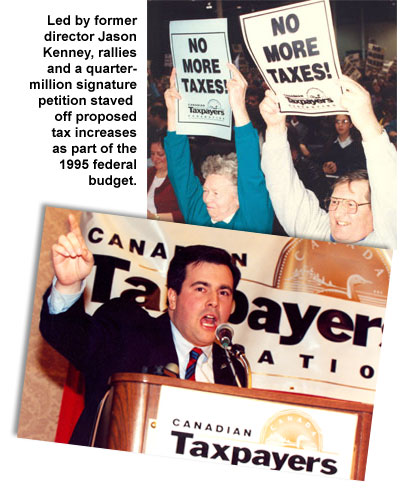
In its January 12, 1995 lead editorial, the Wall Street Journal dubbed Canada “an honorary member of the third world in the unmanageability of its debt problem.” The 1995 federal budget was truly a defining moment in the nation’s history. Paul Martin, in only his second budget, had no choice but to tackle the deficit in a meaningful way. At issue was how he would do it. In the lead-up to that budget, the House of Commons Finance Committee recommended a slew of new taxes. Taxpayers were having none of it. And, unlike the GST five years earlier, taxpayers now had a national advocacy group that could organize pro-actively.
And we did.
Nineteen TAX ALERT rallies from New Brunswick to Vancouver Island attracted 20,000 Canadians and 233,000 petition signatures were delivered to Finance Minister Paul Martin before he delivered his budget. And while the budget did contain some modest tax increases there can be no doubt of the campaign’s impact. On March 1, 1995, in the aftermath of our successful campaign, the Wall Street Journal summed: “The grass roots campaign … had an impact, Mr. Martin was able to sell deeper spending cuts to his cabinet colleagues and steer them from raising taxes on personal income.” Not only did the campaign stop major tax increases, it elevated the CTF to national prominence.
BALANCED BUDGET/TAXPAYER PROTECTION LAWS
Voluntary compliance on the
part of politicians to balance the books, reduce debt and hold the line on
taxes has proven a failure. As past CTF president Jason Kenney used to say
“we’re in the 25th year of the government’s five year balanced budget plan.”
As early as 1994, CTF researchers went to work drafting model balanced budget/taxpayer protection legislation that would broadly do three things: balance the budget, require voter approval for new or increased taxes and penalize politicians for non-compliance.
Each province -- where the CTF had a presence -- responded. Saskatchewan passed a balanced budget law. As did Alberta. More important, Alberta’s included a debt retirement provision and in 1999 added a further provision requiring three-quarters of any surplus be directed toward debt repayment. A law passed in British Columbia in 2001 requires balanced budgets and penalizes ministers for overspending their ministry budgets.
Manitoba passed the first comprehensive taxpayer protection law in 1995. The Act included requirements for balanced budgets, referendums on major tax hikes and mandatory debt retirement. Ontario also passed a comprehensive taxpayer protection law (1999) in the wake of Mike Harris’ signature on the CTF’s Taxpayer Protection Pledge during the 1995 Ontario provincial election.
The benefits of these laws included debt repayment, lower interest costs and the ability of governments to finally reduce taxes. On March 31, 2005 Alberta became the first debt-free jurisdiction in the country!
Unfortunately, many of these laws are being gutted. Even before the recent economic downturn, former premier Ernie Eves weakened Ontario’s law and his successor Dalton McGuinty neutered what was left. BC’s law was amended twice in 2009 as was Manitoba’s in 2008 and 2009. Alberta returned to big deficits in a big way in 2008.
The CTF believes that with the exception of emergencies, federal and provincial governments should be required to balance their budgets like households, municipalities and states in the US. A more potent brand of the CTF-inspired balanced budget/taxpayer protection laws – perhaps voter protected -- is needed. We’ve won this battle before, and can win it again.

THE BRACKET CREEP SQUEEZE
In the mid-1990s Canadians were well aware that harder work and more income was not getting them any further ahead. Although it was not well known, the problem was called “bracket creep.” In 1985, the federal government “de-indexed” the income tax system exposing a greater share of Canadians inflation-driven incomes to taxes each year.
The result: After 14 years of this stealth tax, the federal and provincial governments had netted $90-billion in new revenue.
In CTF pre-budget submissions in 1997, 1998, and 1999 the CTF demanded full re-indexation of the income tax system. And while the CTF was successful in convincing the House of Commons Finance Committee and the Alberta government, others proved a tougher nut to crack. So out came the cannons.
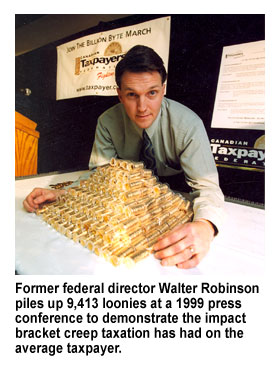
First in 1998, and then again in 1999, national campaigns aimed at eliminating bracket creep and lowering overall taxes were launched. The press conference launch in 1999 included 9,418 stacked loonies to show the impact bracket creep had on the average wage earner over the past decade. The campaigns also included comprehensive research, a cross-country speaking tour, billboards and a massive on-line petition drive called the “Billion-Byte March.”
Our efforts were rewarded with the announced death of bracket creep on February 28, 2000. The campaign has saved taxpayers some $20-billion. Then Minister of Finance Paul Martin wrote: “The Federation is an important and valued voice in decision making … nowhere is this more evident than in the leading role that the Federation played in educating Canadians about bracket creep and building support for re-indexation of the tax system.”
AN END TO
CORPORATE WELFARE
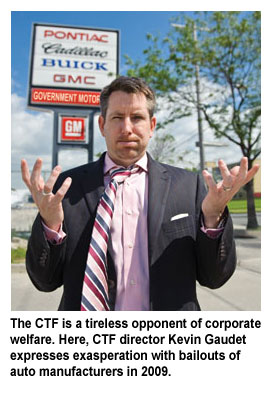
In every province and federally, the CTF has long demanded not only an end to corporate welfare, but legislation preventing the practice. A significant victory was won in Alberta with the 1996 passage of the Business Financial Assistance Limitation Act which prohibits new loans and guarantees from being issued without the passage of specific legislation, ensuring full public debate before tax dollars can be sunk into any business venture. It is the only jurisdiction in Canada with such a law in place.
Federally, the CTF was hopeful back in 2006 when the Conservative Party under Stephen Harper had campaigned on eliminating corporate welfare and regional development agencies. However, since taking office, these programs have actually expanded.
DEMOCRATIC REFORM
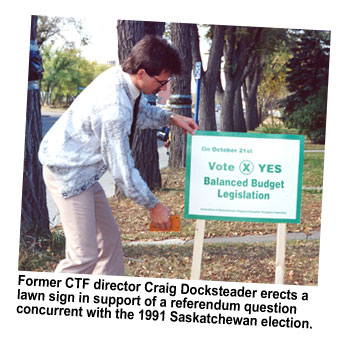
So much of what the CTF deals with – high taxes, debt, wasteful spending – is symptomatic of a much larger problem. That problem, simply put, is that our current political system fails to be accountable to the people who pay for it. For years – through commentaries, legislative presentations, reports, campaigns and conferences – the CTF has advanced the need to empower taxpayers through meaningful democratic reforms like citizen-initiated referendum, recall, whistleblower protection, embolden access to information laws and alternatives to our current voting system.
In 1991, we successfully pushed
the Saskatchewan government for a province-wide referendum question on
citizen-initiated referendum legislation which was supported by 80% of voters.
In Alberta, we twice supported private members bills that came just short of
passing.
In British Columbia a provincial Recall and Initiative Act was passed – albeit with extremely high thresholds -- as was local referendum legislation in Ontario. Voter approval mechanisms for new or higher taxes was a central ingredient in taxpayer protection laws in both Manitoba and Ontario. The latter unfortunately gutted in 2004.
In 1997, the CTF successfully fought off a Charter challenge of British Columbia’s recall law. We also got the province’s “gag law” taken off the books in 2001 and led the campaign for a province-wide referendum on adopting a new voting system. The province-wide referendum received 57% of the vote on May 17, 2005. Similar referendum questions fell short of the 60% threshold in Prince Edward Island 2005, Ontario 2007 and British Columbia 2009. In 2008, the British Columbia government passed a new gag law even more draconian than the one they had abolished in 2001.
A scandal ridden federal government paved the way first, for proactive expense disclosure in 2004 followed by the Federal Accountability Act in 2006 which changed rules surrounding political party donations, lobbying, appointments, government contracts and advertising.
Protection is in place for
whistleblowers and the power of the auditor general and comptroller general is
enhanced. While the Act stopped short of access to information reforms, it was
a big step in the right direction and one supported by the CTF which had been
championing many of these changes for years.
Another long-time democratic reform priority of the CTF is to either abolish or reform the unelected, unaccountable Senate. In 2006, legislation came forward that requires appointments to the Senate to first be elected by voters in the provinces and second, limits their terms.
JUNK MAIL JUNKED
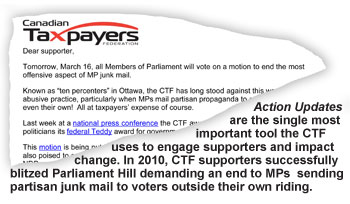
Shortly
after the dubious award received national media attention, a Liberal MP put
forward a motion to stop MPs from mailing flyers outside of their own ridings.
The CTF quickly e-mailed our supporters across the country and encouraged them
to let their MP know that taxpayers didn’t want to fund their junk mail
campaigns, let alone keep receiving them. CTF supporters bombarded their MP’s
offices with calls, faxes, e-mails and letters demanding they vote in favour of
the bill. Although Conservative MPs voted against the measure, it still passed
140-137 with the support of the Opposition parties.
MPs are no longer allowed to mail junk flyers to ridings outside their own saving taxpayers $10 million a year and a few trees in the process.
NO NEW MUNICIPAL TAXES
Despite taxpayers being squeezed by three and sometimes four levels of government – none are seeking to expand their scope more than municipalities. The CTF waged its first battle on the West Coast in 2000 when the Greater Vancouver Transit Authority (TransLink) attempted to bring in a $75 per vehicle registration tax. A successful CTF petition drive along with news releases, an examination of TransLink’s costs, and a coalition of organizations in opposition convinced the provincial government to refuse to collect the tax for TransLink, thereby killing the tax grab.
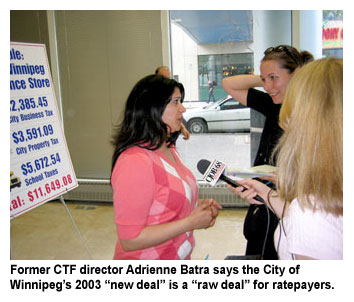
In 2003, the former mayor of
Winnipeg proposed a “new deal” which offered lower property taxes in exchange
for a liquor tax, a city sales tax, a city gas tax, an energy tax on natural
gas and electricity, a hotel room tax, a telephone tax, a sewage and water tax
increase and a user fee on garbage removal. The CTF was the first to call the
proposal a tax grab and quickly organized public opposition leading to a new
mayor that committed to examining the spending side of the equation and killed
any new taxes.
In 2006 the province of Ontario passed the City of Toronto Act which allows that city to impose new taxes. In 2007, Toronto proposed ten new taxes on everything from theatre tickets to purchasing a home. The CTF led opposition to the taxes with an analysis showing it could cost the average homeowner $1,182. An effort involving a petition, commissioned poll revealing 74% opposed, a phone-in campaign, and presentation at committee hearings resulted in city council temporarily deferring a decision. Unfortunately, the hammer came down in October 2008 with a new car registration tax, a new land transfer tax, and a new garbage tax. Fortunately, our efforts meant it was only three new taxes and not ten. The first act of a new Toronto mayor elected in 2010 was to eliminate the “car tax” with eyes now fixed on the land transfer tax.
In March 2007, a Minister’s Council on Municipal Sustainability recommended the province of Alberta give local governments the right to levy six new taxes, including: land-transfer taxes, entertainment taxes, hotel taxes, and vehicle registration taxes. The CTF led opposition to the taxes with news releases, published commentaries, and TaxAction Alerts to CTF supporters urging Albertans to contact their politicians. The CTF also released calculations showing that these new taxes could cost an Alberta family of four an additional $911 per year. In the summer of 2007, Premier Stelmach wisely told mayors to put the taxing powers on the fall municipal ballot if they wanted them so badly. None did. In responding to the proposal in September 2008, Municipal Affairs Minister, Ray Danyluk, stated “if I can say it in one word: NO.”
The CTF opposes all new taxes on the grounds that “new” taxes never replace “old” taxes. They simply provide politicians more taxing levers and less incentive to look at the spending side of the ledger.
TAX CUTS 2005 - 2007
It seems that tax cuts hit the radar screen every five years. The CTF organized cross-country rallies opposing proposed new taxes in 1995, successfully fought to eliminate bracket creep and reduce income tax rates in 2000 and in 2005 played a leading national role in bringing taxes down yet again.
After years of demanding
excessive federal surpluses be returned to taxpayers, on the eve of an election
call in November 2005 the Liberal government announced an immediate and
retroactive reduction of the bottom income tax rate and an increase to the
Basic Personal Exemption worth $4.5-billion. Long time CTF priorities -- tax
relief and accountability -- were the top two issues of the 2005/2006 federal
election campaign. As such, the CTF played a larger role than it ever had in providing
commentary and analysis during a federal election campaign.
The 2006 federal budget was the first delivered by a Conservative government in 13 years. At issue however was whether income taxes would be raised to allow for a promised 1 point reduction in GST. The CTF provided analysis, issued media statements, published commentaries and earned editorial praise right across the country. We met with politicians and decision makers. And urged CTF supporters by the thousand to contact the finance minister and prime minister before budget day. The effort paid off. Along with a GST cut almost all the previous income tax reductions remained intact – no taxpayer was worse off.
The morning after the 2006 budget, the CTF led reaction on front pages of both the Globe and Mail and National Post. As Maclean’s Magazine editor-in-chief Ken Whyte put it succinctly: “The Canadian Taxpayers Federation dominated coverage of this year’s budget.” An Economic Statement delivered in October 2007 cut the GST a further point to 5%, reduced the lowest income tax bracket a half point, increased the Basic Personal Exemption and scheduled a reduction in the general business tax rate from 22% to 15% by 2012.
Not only were these tax cuts measurable, but they were broad-based and accountable (keeping an important election promise to reduce the GST by two points). The CTF had been lobbying hard against “boutique tax cuts” that benefited some, but not all taxpayers. The October 2007 Economic Statement changed policy course and was praised by the CTF.
FREEDOM OF
INFORMATION LAWS
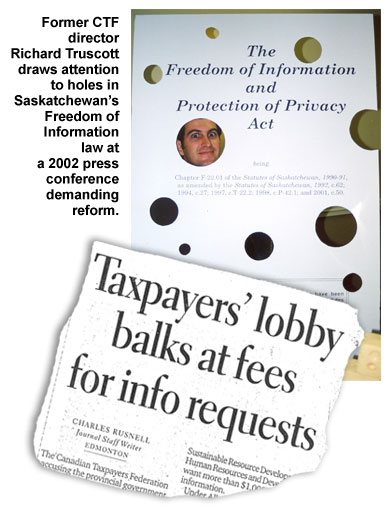
The CTF has both played champion and defender of Freedom of Information (FOI) laws. The public has a right to know how their dollars are being spent and from its inception the CTF has fought to pry the closed doors of government open.
Major petition drives in 1990 in both Saskatchewan and Alberta eventually led to the implementation of laws in those two provinces. Since that time the CTF has participated in every opportunity to make the legislation more open and accessible. In British Columbia and Manitoba the CTF was instrumental in both forming and maintaining coalitions that successfully staved off proposed changes that would have weakened laws.
Predictably, politicians are big fans of access to government information – right up until they get into government! Each year the CTF works with a cross-section of groups in the provinces and federally to mark “Right to Know Week” promoting the importance of access laws. The CTF and its offices are major users of FOI. Many of the waste stories documented by the CTF over the years have come about as a result of FOI requests made to government.
DEDICATED GAS TAXES
Each year the CTF holds Gas Tax Honesty Day which blows the whistle on government tax gouging at the pumps and demands gas taxes be reinvested into roads and infrastructure. Unbeknownst to most consumers, a third of the pump price of gasoline is tax!
When the event began in 1999, less than 42% of gas taxes collected by all levels of government was put back into “infrastructure,” and only 2% of what the feds collected was. Our message to governments on fuel taxes: “use it or lose it,” direct half into a Municipal Roadway Trust and return the remainder to motorists and taxpayers in the form of lower fuel taxes.
To date, over 150,000 Canadians
(including 2,046 mayors and councilors from 459 communities) have signed the
CTF’s gas tax petition demanding lower and dedicated fuel taxes.
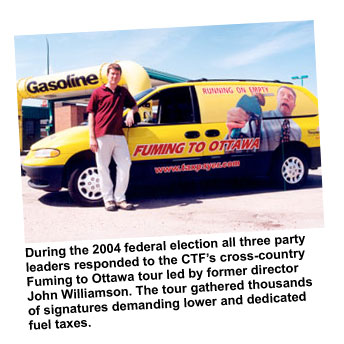
During the 2004 federal election campaign, the CTF drove a decorated mini-van from Mile 0 of the TransCanada Highway in Victoria, BC all the way to Parliament Hill. The “Running on Empty, Fuming to Ottawa Tour” stopped in 40 communities, conducted countless media interviews, collected signatures and talked to thousands of taxpaying motorists. The campaign resulted in all three major party leaders finally making commitments to dedicate a portion of the federal fuel tax to municipal roads and infrastructure. Stephen Harper even declared as opposition leader at the time that he would lower fuel taxes if elected prime minister …
And while gas taxes have yet to come down (the feds still apply GST/HST to gas taxes) significant progress has been made dedicating fuel taxes to roads and infrastructure. By 2008, more than 100% of what the governments collect in gas taxes is reinvested into “infrastructure.” Although “infrastructure” has a somewhat dubious definition (think canoe museums, and bocce ball courts), we know much progress has been made since the CTF began its efforts in 1999.
Provinces meanwhile have gone a step further. Manitoba passed a Gas Tax Accountability Act in 2004 requiring fuel tax revenues be dedicated to roads. Two years later, Saskatchewan followed suit. The province of New Brunswick cut gas taxes in 2006.
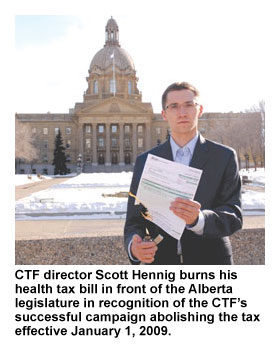
ALBERTA HEALTH TAX ABOLITION
Most public policy victories
involve other advocates. But not in this instance. In 2003 when the CTF
initiated a campaign to abolish Alberta’s health tax it was ignored by
mainstream media and dismissed by decision makers. But the case against the
health tax was clear: it did not pay for health care, it had nothing to do with
insurance, it was costly to administer, and it was regressive. The CTF
published analysis, distributed commentaries, and used polling data to
demonstrate public opposition. With each passing year, CTF directors marched in
a mounting pile of petitions to lawmakers and made the case. First, it was
opposition parties that came on side followed by the government eliminating the
health tax … for seniors. Momentum had swung!
On the eve of calling a provincial election in 2008, Alberta Premier Ed Stelmach announced health care premiums would be scrapped for all Albertans. It meant each Alberta family would keep an additional $1,056 of their earnings. Every major media outlet in the province – Canadian Press, Calgary Herald, Edmonton Journal and the Globe and Mail – credited the CTF for the victory. As the Edmonton Sun put it: “the Canadian Taxpayers Federation campaigned tirelessly to get the premium scrapped.”
Canada's Federal Debt
Your Share
The federal government is adding $88 million a day to our debt. At this rate, the $105-billion in debt repayment between 1997 – 2008 will be wiped out this year. Support our campaign for a federal balanced budget law and help us STOP this clock.
Spokespeople & Blog
In five provinces and Ottawa a team of dedicated professionals is standing up to special interests, ensuring that taxpayers' voices are being heard.
In The News
-
Time for a public-sector pension wake-up call
read more » -
Canada's MPs and their well-padded pensions
read more » -
MP Pensions News Conference
read more » -
CTF calls for cuts to MP pensions
read more » -
MPs must lead by example
read more » -
Reform MP Pensions
read more » -
Concerns on rising costs at Canadian Museum of Human Rights
read more » -
99 Really Stupid Things the Government Did With Your Money
read more » -
Taxman strikes in 2012
read more » -
2012 brings higher payroll taxes
read more » -
Nibbled to death in BC
read more » -
Free Admission?
read more » -
BC hit hard in 2012
read more » -
Who should determine Alberta MLA pay?
read more » -
Is Ottawa's Energy Rebate program effective?
read more » -
Welcome to 2012: All debt, all the time
read more » -
Peter Mackay's expense claims
read more » -
Considering a P3 model for new Rider stadium
read more » -
Winnipeg's photo radar controversy
read more » -
Peter Mackay goes POSH
read more » -
Interview with Chief Janette Peterson
read more » -
Newly elected chief looks to reduce salary
read more » -
ICBC wants a rate increase
read more » -
What is behind the problems on Attawapiskat Indian Reserve?
read more »